
Elk River Resident Lookup Records
Different records answer different questions. A property result ties a named owner to a parcel, not necessarily to every person at that address. A voter public-list response is a carefully limited registration clue. Court and vital materials each have their own access rules. For an Elk River resident lookup, choose the first record by the fact to be confirmed, then use another custodian to test the match. The official route is more dependable than treating one old listing as a current answer.
| Record | What it can confirm | Official keeper | Access path |
|---|---|---|---|
| Parcel and GIS record | Owner of record, situs, mailing address, PID, legal description, values | Sherburne Beacon and county GIS | Basic parcel data is free; CAMA details can carry a fee |
| Recorded land document | Title instrument, named parties, document history | RecordEASE and Recorder counter | Payment/login online; counter and document-number request alternatives |
| Voter public list | Name, address, year of birth, voting history, districts | Sherburne Elections | Registered Minnesota voter and written lawful-purpose request required |
| Court case record | Party, case details, hearings, filings, disposition | Minnesota Court Records Online | Remote view is limited and unofficial; courthouse access is broader |
| Vital index or copy | Birth, death, marriage, or divorce lead | Minnesota Department of Health, county, or court | Index and copy rules differ by event and eligibility |
| License or business filing | Public credential, entity, or affiliation | Minnesota DLI or Secretary of State | Public search, but it does not establish a home address |
Begin with property or GIS only when ownership is relevant. Begin with a lawful voter request when registration is the issue. A probate, obituary, or recorded deed can be a better starting point for an heir question. For a person in a historical directory, compare the printed date with a later parcel, court, or vital record before treating the entry as current.
Note: Keep the record date with each result because parcel ownership, registration, and case status can change after a search.
Triangulating an Elk River Resident
Name matching is only a starting point. Match at least two independent identifiers before deciding that records belong to one person: a full name with middle initial, an approximate age or date of birth, a parcel or legal description, a county, a spouse or parent, or a distinctive dated event. The county parcel layer can supply a PID, which is a parcel identification number. If a mailing address differs from the situs address, label it as tax correspondence, not as a residence. A homestead flag is an assessment classification, not an occupant list.
Run practical name variants. Try a maiden name, an initial in place of a middle name, a hyphenated form, a compound surname, and a spelling variation. MCRO offers exact-name, trailing-wildcard, and Sounds Like options. A trailing wildcard needs at least two characters, and Sounds Like cannot be combined with the wildcard. The BCA criminal-history search is a separate official channel requiring last name, first name, and date of birth, but it is not a substitute for a court file. A no-result in one system should not be turned into a conclusion about a person.
Voter information follows a separate statutory route under Minn. Stat. §201.091. A registered Minnesota voter may inspect the public information list without charge and may request a copy or electronic medium with identification and a written lawful-purpose statement for elections, political activities, or law enforcement. The list can include name, address, year of birth, voting history, a supplied phone number, and districts, but it does not include full date of birth or an unrestricted online name search. Use the individual voter-information request form for a narrow inquiry sent to the county auditor where the voter lives.
MCRO Fields for Elk River Resident Lookup
Elk River cases are handled through Sherburne County District Court in Minnesota's Tenth Judicial District. The statewide MCRO Case Search gives a structured way to test a name against court records without treating a case as a complete personal profile. Select the Name tab, use the county picker when a Sherburne-focused search is appropriate, and narrow only with facts that are already reliable. MCRO is not the official certified record.
| MCRO Name field | Documented use |
|---|---|
| Name Type, Last Name, First Name, Middle Name | Build the party-name search and test name variants |
| Date of Birth | Use an exact date or a date range when a reliable date is known |
| Date Filed | Limit results to an exact filing date or date range |
| Case Category and Case Status | Narrow among Civil, Criminal, Family, Probate or Mental Health, and status choices |
| Court Locations | Search statewide or select Sherburne and other county locations |
The official case-search interface is shown below from MCRO Case Search.
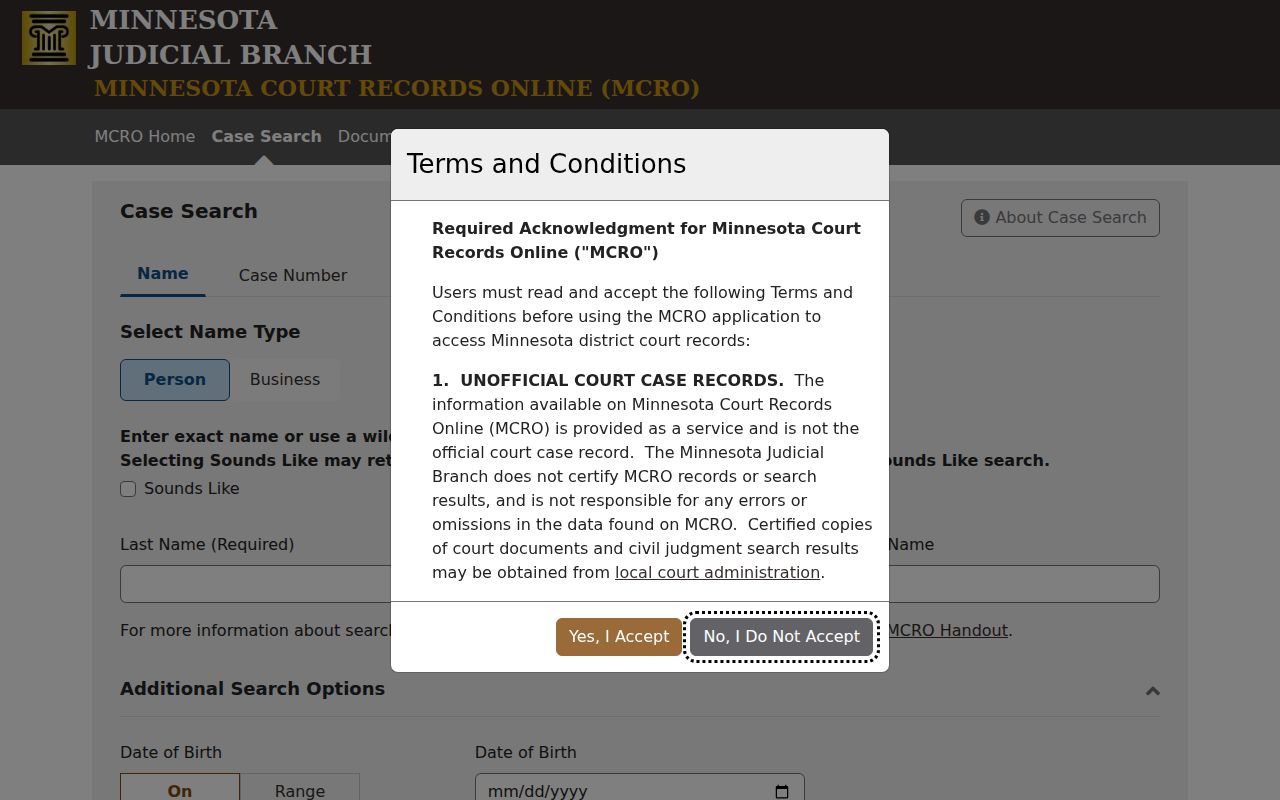
A result may expose the case number, case type or category, court location, party names and roles, case details, hearings, monetary-judgment details, Register of Actions, public documents, and filing or disposition information when remotely available.
- Case number identifies the court file for a follow-up request.
- Party role distinguishes people with the same surname.
- Register of Actions lists entries made in the case.
- Filing and disposition dates help place the record in time.
- Public-document availability does not mean every document is remotely visible.
Courthouse Access Beyond MCRO
MCRO's remote results have Rule 8 limits. Domestic abuse, orders for protection, harassment restraining orders, CHIPS, many juvenile matters, civil-commitment material, protected party street addresses and comments, and some pending criminal, traffic, and petty-misdemeanor results from a name search can be withheld. A case-number search may show more than a name search, yet it still displays only material classified as remotely available. That limitation makes a careful searcher avoid treating the online view as the whole file.
Public Access Courthouse terminals provide a more complete statewide electronic view of public records than the remote portal. Sherburne District Court also has counter access to locally stored paper files. For copies, use the Judicial Branch request guidance with the case name, file number if known, exact document, return name and address, and a daytime phone number. Plain copies generally have no fee; certified-copy charges follow the court schedule. Some files are offsite or on microfilm, so prompt service cannot be assumed.
The official MCRO Document Search uses a case number rather than a person-name field.
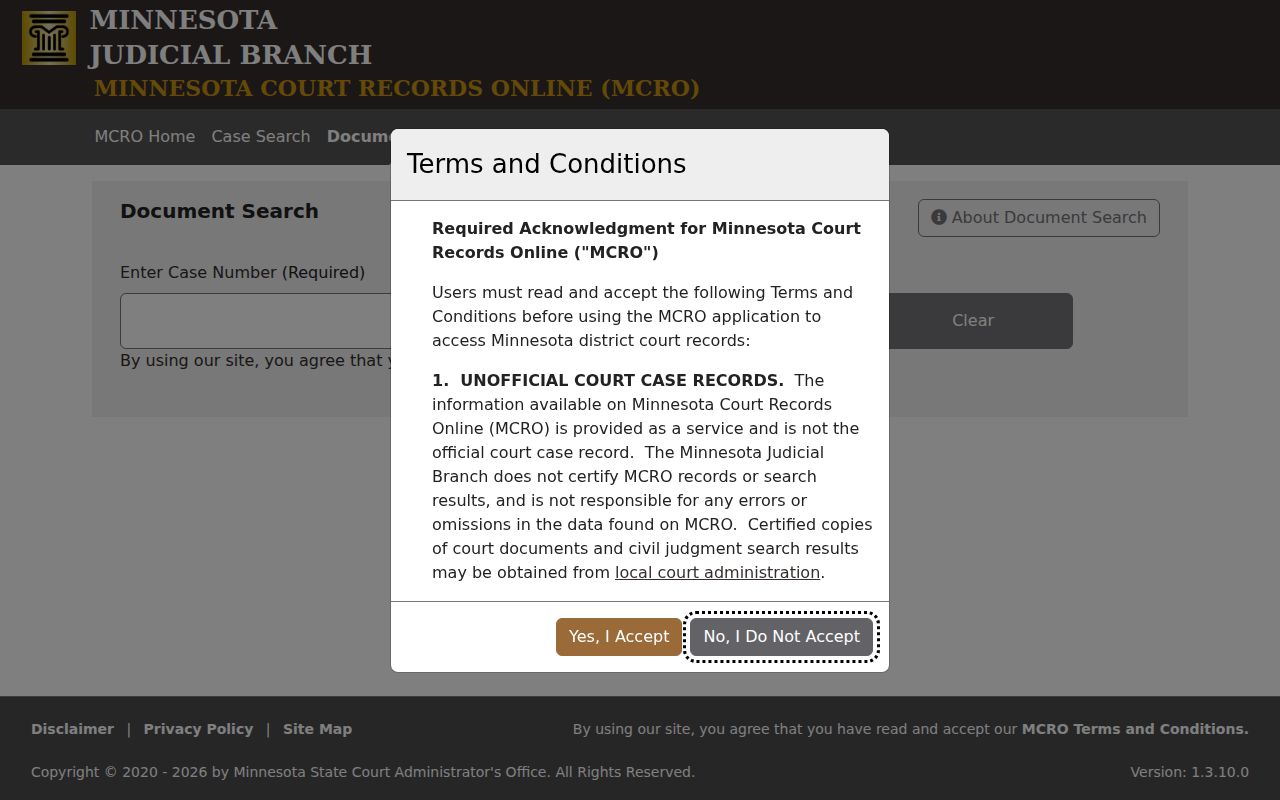
Once a case number is confirmed, this route can identify public documents where they are available, while a certified copy still comes from the court custodian.
Note: A courthouse terminal can reveal public material missing from remote MCRO, but sealed or legally restricted records remain unavailable.
Elk River Vital Record Paths
Vital records are evidence with strong access boundaries. For an Elk River event, the county vital-record office may be faster, while the Minnesota Department of Health is the statewide issuing and search authority. MDH processes applications by mail, fax, or courier rather than an ordinary in-person counter. Birth records held statewide begin in 1900 and death records begin in 1908. Marriage copies come from the county that issued the license, while divorce decrees come from the District Court that entered them.
The Minnesota Department of Health vital-records service explains the separate birth and death routes.
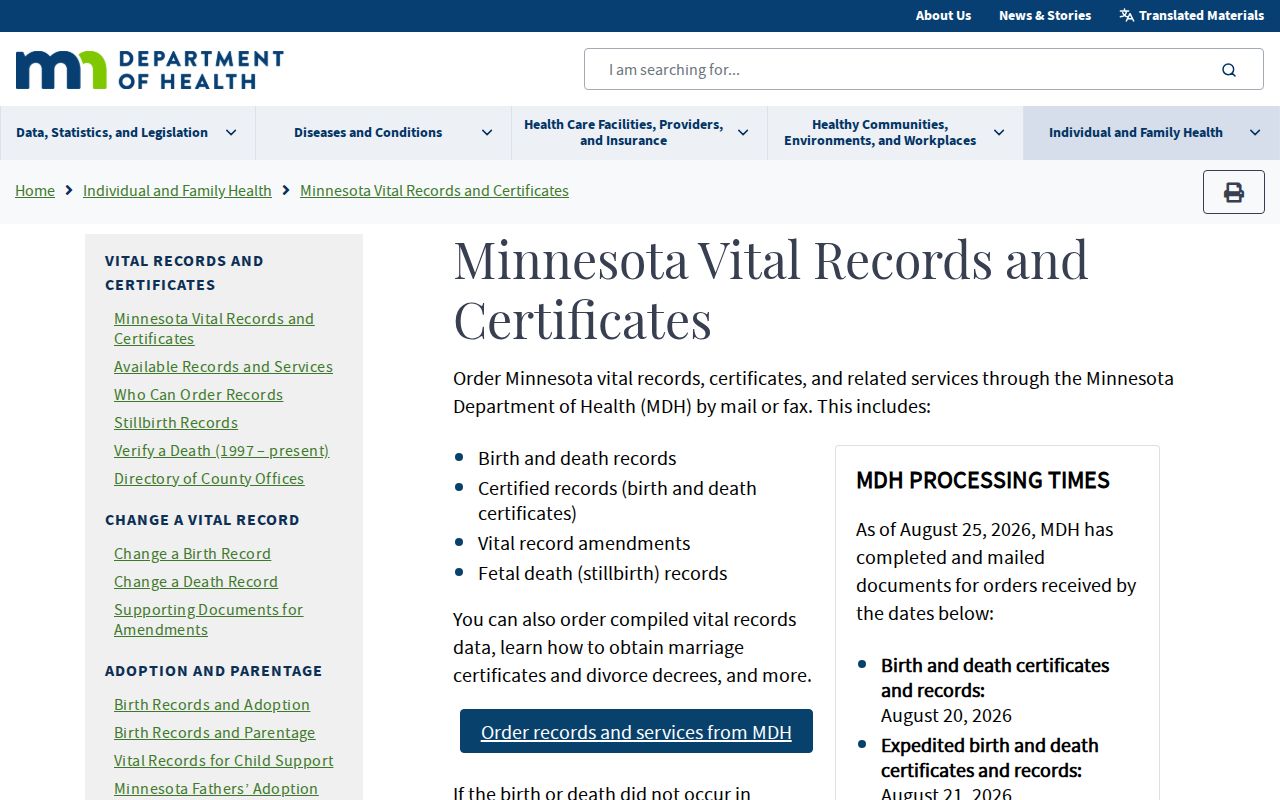
Use an index for a genealogy lead, then seek a certified copy only through the relevant eligibility and application process. Birth applications require the subject's identifying facts, parent information, requester information, a qualifying relationship or authority, and notarization. Incomplete, unpaid, or unnotarized applications are returned.
The MDH death-verification search requires first and last name plus either date of birth or Social Security number, with one exact match route.
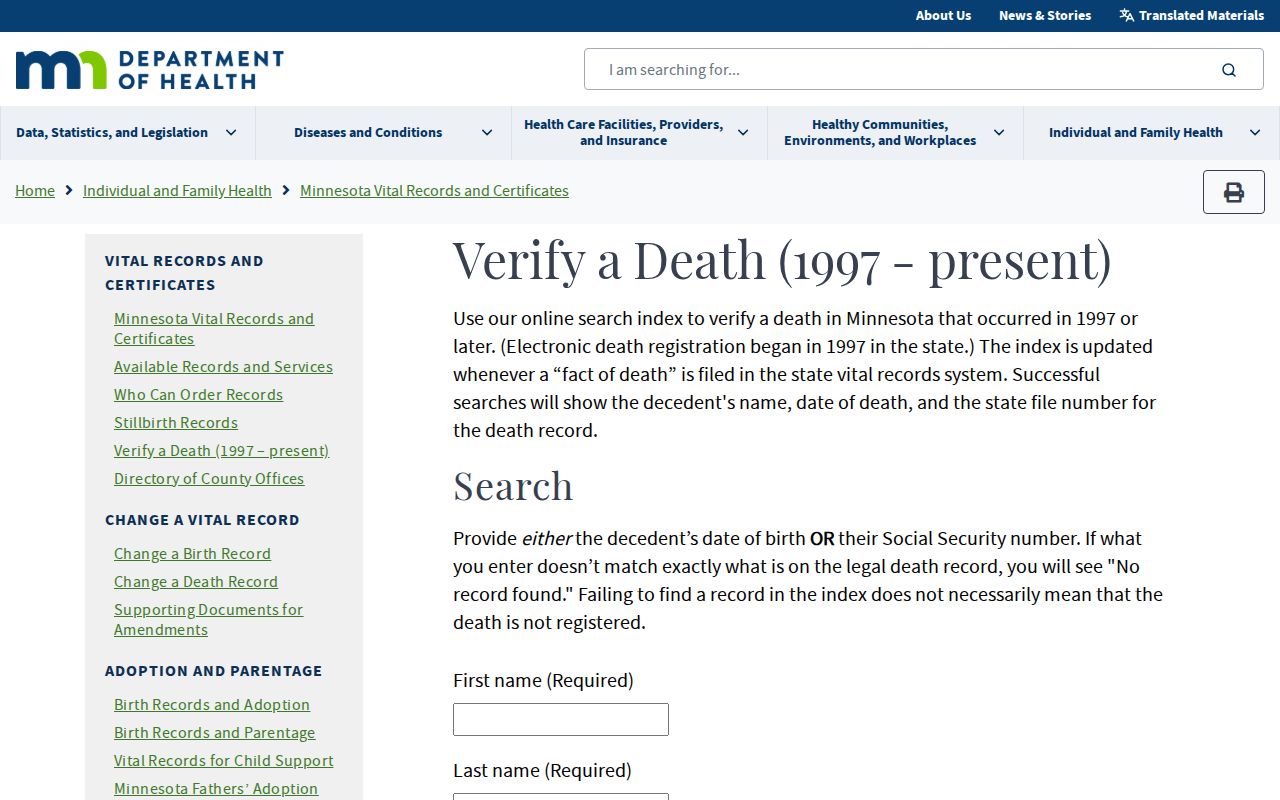
A matching death-verification result gives a date of death and a state file number. Electronic registration began in 1997, so a no-match does not prove that no registration exists. Minn. Stat. §144.225 controls public and confidential vital data, including restricted birth information and eligible-copy rules.
Correcting an Elk River Resident Lookup
Send a correction question to the custodian that owns the disputed record. The Assessor handles parcel data, the Recorder handles recorded documents, Elections handles voter data, the BCA handles a criminal-history review, MDH handles vital records, and Court Administration handles a case file. Give the office the record identifier, the precise field believed to be wrong, the source for the correction, and the date viewed. Do not ask staff to disclose data that is restricted from public access.
Minnesota's Government Data Practices Act, Minn. Stat. ch. 13, is the general government-data route. Inspection of public data is free; copy charges may reflect actual costs, with a stated 25-cent ceiling for 100 or fewer black-and-white letter or legal pages. It does not override the separate court, voter, or vital-record rules. When a routine online search fails, use the custodian's request form, a court copy request, an elections form, an MDH application, or a library or archive appointment that fits the record type.
Safe at Home is a separate protection. The Minnesota Safe at Home program gives eligible participants a substitute post-office-box address while the real address receives confidential handling. Voter safety statements can withhold a name, and Rule 8 limits access to certain court data. Do not attempt to reconstruct a protected address from indirect records.
DLI Licenses for Elk River Residents
A license record can help distinguish people with similar names when it confirms a public credential or affiliation. It cannot establish where someone lives. Minnesota's Department of Labor and Industry iMS portal allows guest searching by a complete license or registration number, or through its Search License/Registration holders option. The detailed criteria vary by board. Results can include status, continuing education, work experience, plumbing bond holders, and enforcement-action information when applicable.
The official Minnesota DLI license and registration lookup is the appropriate source for that limited confirmation.
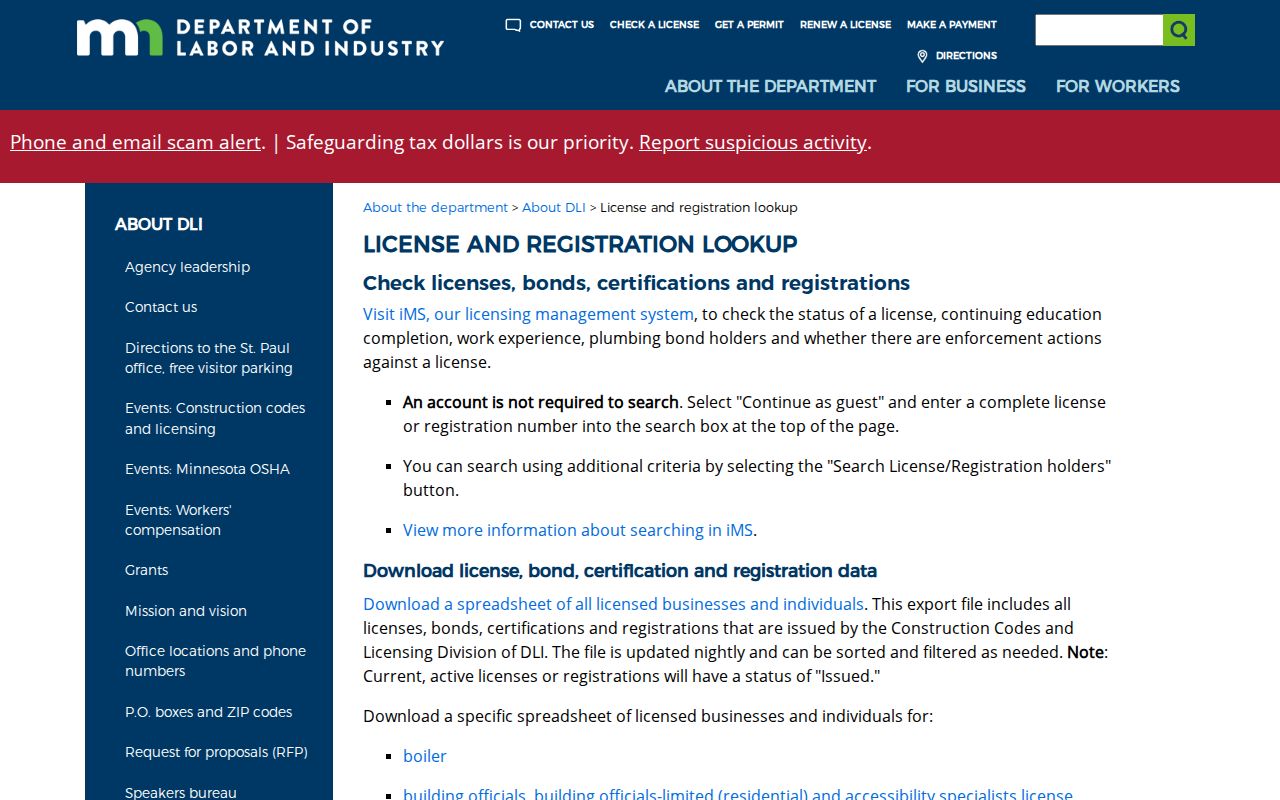
Record the license number, status, and date with the name result, then corroborate the person through another source when identity matters. Minnesota board-specific tools may handle other credential types, and the Secretary of State business filing search can separately show an entity's filing or renewal history.
Note: Treat a license result as evidence of a credential or affiliation, not as a current-address record.
Verify an Elk River Resident
A disciplined resident lookup records both the supporting facts and each limit. Start with a name and an address only when the source permits the search. Then connect the result to one separate official record. A link in the chain can be a PID, a case number, a date of death, an issuing county, or a public filing. Those identifying details are more useful than repeatedly searching a bare surname.
- Use Beacon or GIS to identify a parcel owner, PID, situs, mailing address, and legal description when the question concerns property.
- Request voter information only through the statutory form and only for the permitted purpose. A public-list result is a registration clue, not proof of present occupancy.
- Search MCRO with name variants, county, dates, and category controls. Save the case number and verify any important item through the court.
- Use an MDH or MNHS index for dated family facts, then follow certified-copy rules if an official copy is needed.
- Docket
- A court's running list of filings, hearings, and actions in one case, often called the Register of Actions in MCRO.
- Index versus image
- An index points to a record or gives summary fields; an image is the underlying scanned document and may have separate access or charges.
- Certified copy
- A copy issued by the legal custodian with its certification, available only under that record type's rules and fees.
Elk River Resident Lookup Limits
Public availability is not a license to assemble or spread sensitive personal details. Minnesota law protects Safe at Home locations, limits voter-file use, restricts many vital-record copies, and withholds some court material from remote MCRO access. A public record also carries a scope limit: an owner is not necessarily an occupant, an old directory is not a live location, and a court case is not a complete account of a person. When a person appears to be wrongfully linked to a record, return to the correct custodian rather than repeating the claim.
Lawful use. Use an Elk River resident lookup for personal, lawful research. Minnesota's harassment and stalking laws prohibit using records to stalk, harass, intimidate, or endanger another person.
Minn. Stat. §609.748 addresses harassment restraining orders, and §609.749 addresses harassment and stalking penalties. Preserve source dates, remove unneeded date-of-birth and phone details from notes, and never publish a Safe at Home location or bulk voter file. For a historical household trail rather than a one-person verification, the Elk River city directory materials provide a separate dated-source route.