
Elk River Previous Residents Sources
One Elk River address has several timelines. The current parcel record supplies the present situs, PID and legal description. Recorded instruments then document title transfers. Directories, assessments, census schedules and local notices supply dated household clues between transfers. A deed should not be treated as proof that its buyer lived on the site, and a directory listing is not a title record. For previous residents, use the table as an era map and save the source, date, address form and legal description with every name.
| Record source | Elk River years | Access point | Useful address clue |
|---|---|---|---|
| Abstract deed index | 1957+ | RecordEASE or Recorder counter | Indexed grantor and grantee documents |
| Abstract deed images | 1851+ | RecordEASE payment access or counter | Historic recorded instruments |
| Torrens index and images | 1910+ | RecordEASE or Recorder counter | Registered-title chain |
| Telephone directories | 1957; 1959-2005 irregular; 2011-2012 yellow-only | MNHS finding aid | Printed phone and address listings |
| St. Cloud Times index | 1928-2008 | GRRL | Notices, obituaries and local events |
| Federal census | Through 1950 currently available | Library and archival sources | Household composition at the census date |
| Assessment rolls | 1859-1901 irregular; sample decades through the 1990s | MNHS county finding aid | Taxable owner and property history |
| Sherburne death index | 1870-1981 | MNHS microfilm and finding aid | Name, date, volume, page and line |
Start with the recorded chain when the question is ownership. Start with a dated directory or census when the question is who lived there before. The two trails meet only after their dates, address form and parcel identity agree. City permit files can provide work or valuation clues by address or PID, but the reviewed city material did not expose a public permit-result search or a verified retention schedule.
Elk River RecordEASE Coverage
The Sherburne RecordEASE portal has an important split in coverage. Its abstract index starts August 10, 1957, but abstract images reach August 1, 1851. Torrens index and image coverage begins December 15, 1910. That means a past-resident trail can reach farther than a simple index search suggests, but access depends on knowing enough to locate the instrument. RecordEASE requires web payment login; its reported occasional-user charges are a $3 convenience or session charge, $0.50 per search, $1.50 per recorded document, and $2.50 for a Torrens certificate, tract page or tract card.
The portal's post-login name, date and document search fields were not inspected in the research. Do not assume a broad address search is available. When an old address fails, retain the legal description, plat, lot, block, PID, book or page, and every document number already found. Those are the keys that can carry an Elk River previous residents search across different address wording and between abstract and Torrens records.
The RecordEASE login is shown on the Recorder's online land-record access.
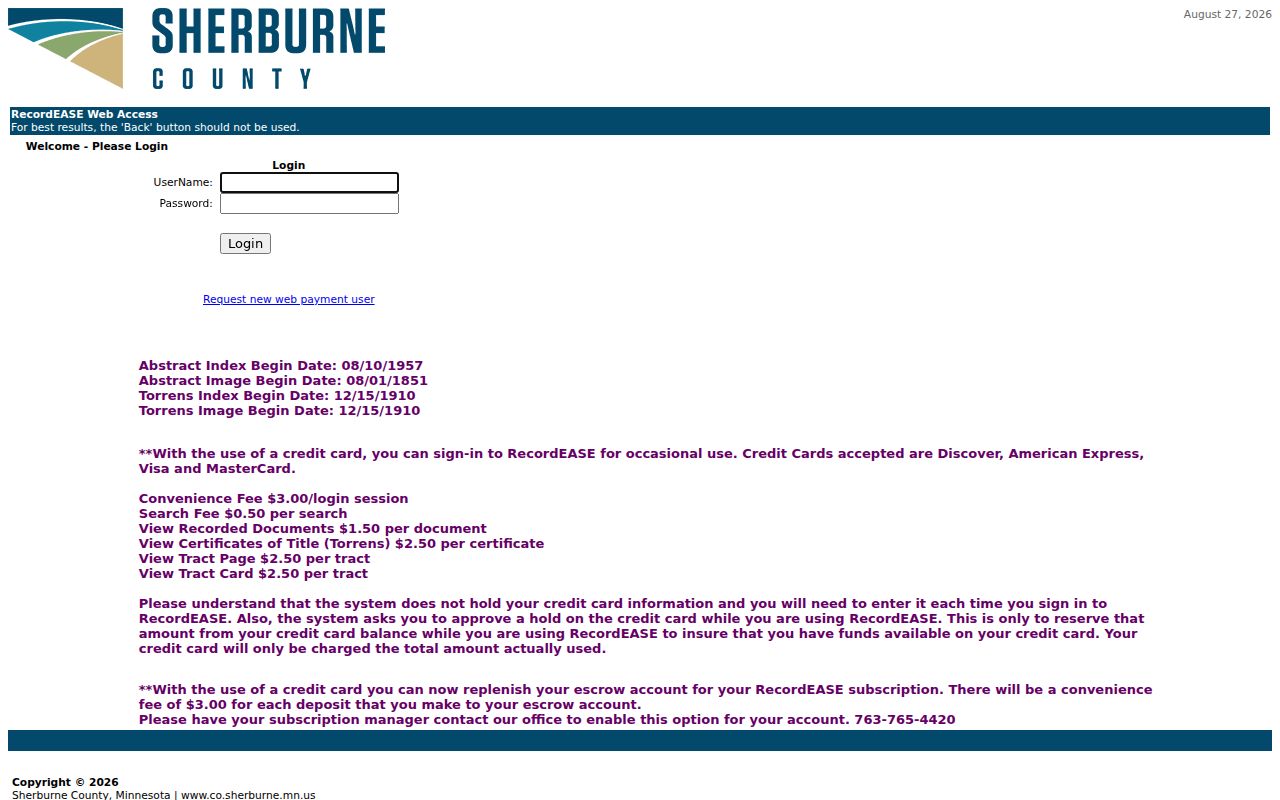
This access screen is a reminder that the older image coverage does not make every deed discoverable without payment, a known document number, counter help, or archival research.
For a copy after the document number is known, the Recorder data-request form accepts fax, mail or email delivery and distinguishes certified from uncertified copies. It requires document numbers and says the office will not look up missing numbers. A blind request for every instrument tied to an address is not the documented route. Note: A document image records a transaction, so read its recording date and parties before connecting it to past residents.
Elk River Previous Residents Deed Chain
Use Sherburne Beacon or the county GIS service to stabilize the present parcel before tracing a deed. County guidance says the basic property view includes an address, classification, estimated market and assessed value, homestead, legal description, PID, school district, section-township-range and tax information. The online page was not fully crawlable, so treat its live field behavior as unverified. The essential result is a stable PID and legal description, not just a street number.
- Locate the present situs in Beacon or GIS and copy the PID, legal description, plat, block, lot and current owner exactly as shown.
- Use the current owner as a grantee search in RecordEASE to locate the acquisition deed. Record the grantor, grantee, document number, date, type and legal description.
- Search that seller as a prior grantee, and also search the same legal description. Compare the parcel language rather than relying on a modern street address.
- Repeat the sequence backward. Switch between abstract and Torrens routes when the title type changes, and keep separate notes for each instrument.
- When the index is insufficient, take the known document number, book or page, tract card, plat or legal description to the Recorder counter or an archival deed-book search.
This is a title chain, not an occupancy chain. A prior owner may have held the property briefly, lived elsewhere, or used a mailing address outside Elk River. Pair each transfer with a directory, assessment, census or obituary before saying someone lived at the address.
- Grantor
- The person or entity transferring an interest in a recorded instrument.
- Grantee
- The person or entity receiving that interest. In a backward search, a former seller can often be found as the grantee on an earlier purchase.
- Chain of title
- The sequence of recorded transfers connected by the same property interest, read from a current instrument back through earlier ones.
- Legal description
- The plat, lot, block, section or other land description used to identify property in records. It is more durable than an address when street wording changes.
Elk River Past Residents Parcel Keys
The county parcel map service ties geometry to PID and exposes fields for building number, street name and type, unit, mailing city and ZIP, plat, block, lot, polygon and deed acres, owner name, owner address, tax mailing address and estimated market values. GIS is the bridge from a mapped parcel to the assessor and Recorder. Its query service has a 2,000-record limit, so use a single address, PID or legal description rather than treating it as a complete people list.
Keep three fields apart. The situs is the physical parcel location. The mailing address is where tax correspondence goes, and can be in another city or state. The legal description identifies the land in recorded instruments. An owner mailing address can suggest where correspondence was sent at the time of the tax record; it does not establish an owner’s home or identify every household member.
Elk River's 55330 mailing area is larger than city limits. For older searches, the research also advises trying Elk River, Orono, the township, an old plat or subdivision, and county wording beside the modern address. Check the PID and legal description before concluding two similar addresses are the same property.
Elk River Past Residents in Households
Recorded owners are only one part of an Elk River household history. The MNHS telephone-directory finding aid identifies local volumes from 1957 forward, with gaps, supplements and yellow-only years. The official source does not verify an Elk River reverse or criss-cross run. Ask GRRL or the Gale Family Library whether an address-arranged volume exists for the year needed, rather than assuming an alphabetical telephone book can be searched by house number.
- Choose the earliest directory year near the transfer or assessment date and copy the printed name, phone and address without normalizing it.
- Compare the next and prior available volumes for a phone change, address change or a missing listing. A gap or unlisted number is not proof of absence.
- Pair an address clue with the 1940 or 1950 federal census, the latest broadly released full decennial schedules under the 72-year rule.
- Compare the household result with the parcel owner, deed date and tax or assessment record for the same period.
- Use an obituary, probate file or cemetery inquiry to explain a death, executor, heir or departure without assuming the event occurred at the property.
The historical collections themselves have a fuller shelf-by-shelf treatment on the Elk River city directory page. For this backward address task, the goal is a dated overlap: a printed address clue, a released census household and a parcel or deed reference that point to the same place.
Lawful use. Elk River previous residents research can support house history, family history and estate questions. Do not use a dated record to track, watch, threaten or harass a living person; Minnesota law addresses harassment and stalking in Minn. Stat. §609.748 and §609.749.
Elk River Previous Residents Newspapers
Newspapers can fill the space between an address listing and a later deed. The MNHS Star News collection traces a local line from Sherburne County News, published from 1872 to 1875, to Elk River Weekly News in May 1875, then to the Sherburne County Star News after an August 1882 merger. Star News is the current title from April 2003. The Minnesota Digital Newspaper Hub has digitized historical pages and much of the pre-1977 material, while current-title issues are held at the Gale Family Library.
The newspaper collection is represented by the MNHS Star News source.
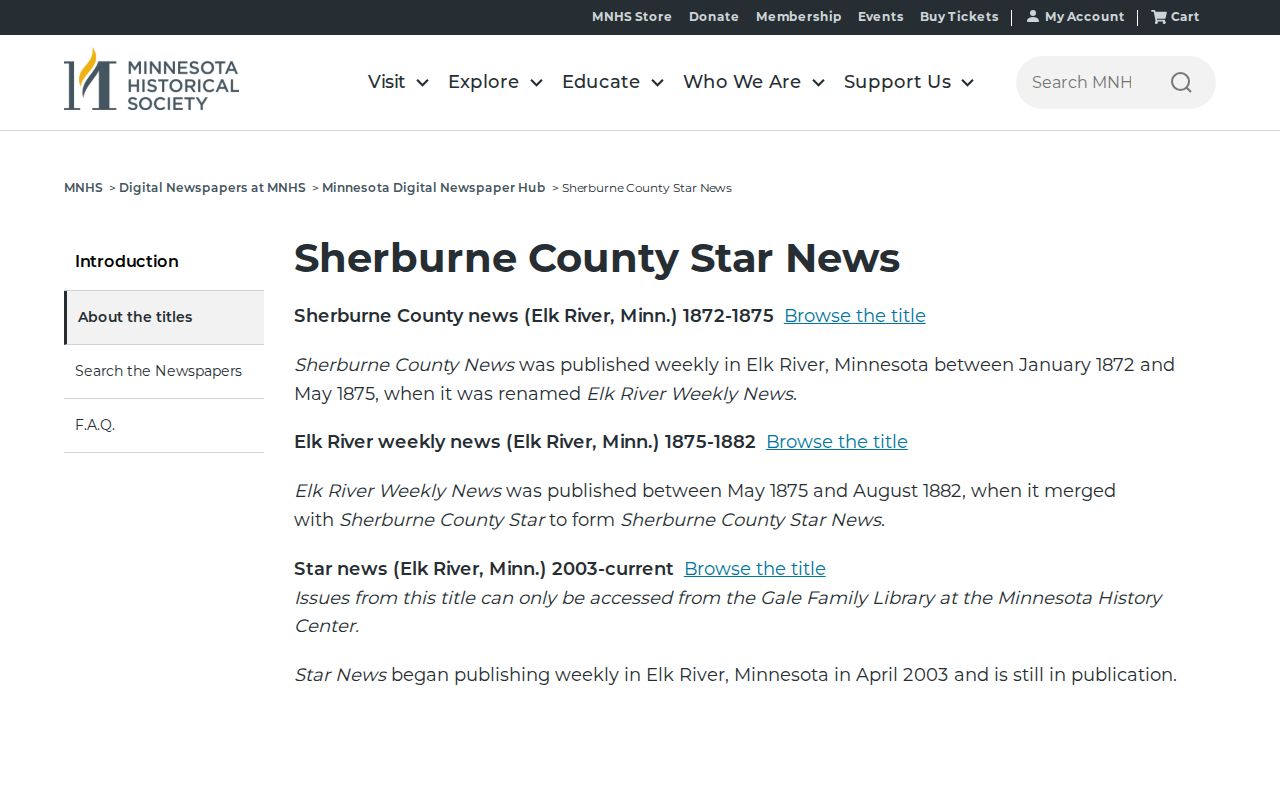
Use a notice as a lead, then confirm a name with the deed, directory, death index, cemetery material or probate file. A surname in an article may identify a family connection, a business or a public event instead of a resident at the address being researched.
For additional notices, GRRL's St. Cloud Times index covers 1928 through 2008 and can be searched by date range and terms. Results give a title and publication date or page, with copies requested through a librarian or branch. The Sherburne death index covers 1870 through 1981, and the county historical sources also describe marriage, court and naturalization indexes. Those are end-point records, not a substitute for confirming the parcel.
Elk River Previous Residents Fallbacks
When the online chain stops, Elk River has two practical research desks. The Elk River Public Library is part of Great River Regional Library and points users to genealogy databases, local history resources and librarian help. GRRL's genealogy resources include in-library Ancestry Library Edition, FamilySearch, Minnesota Historical Society indexes, newspaper resources, MNLINK and interlibrary loan. This is the safer fallback when a directory year, obituary or archive reference needs an actual volume or a copy request.
The library route is shown on the Elk River library page.
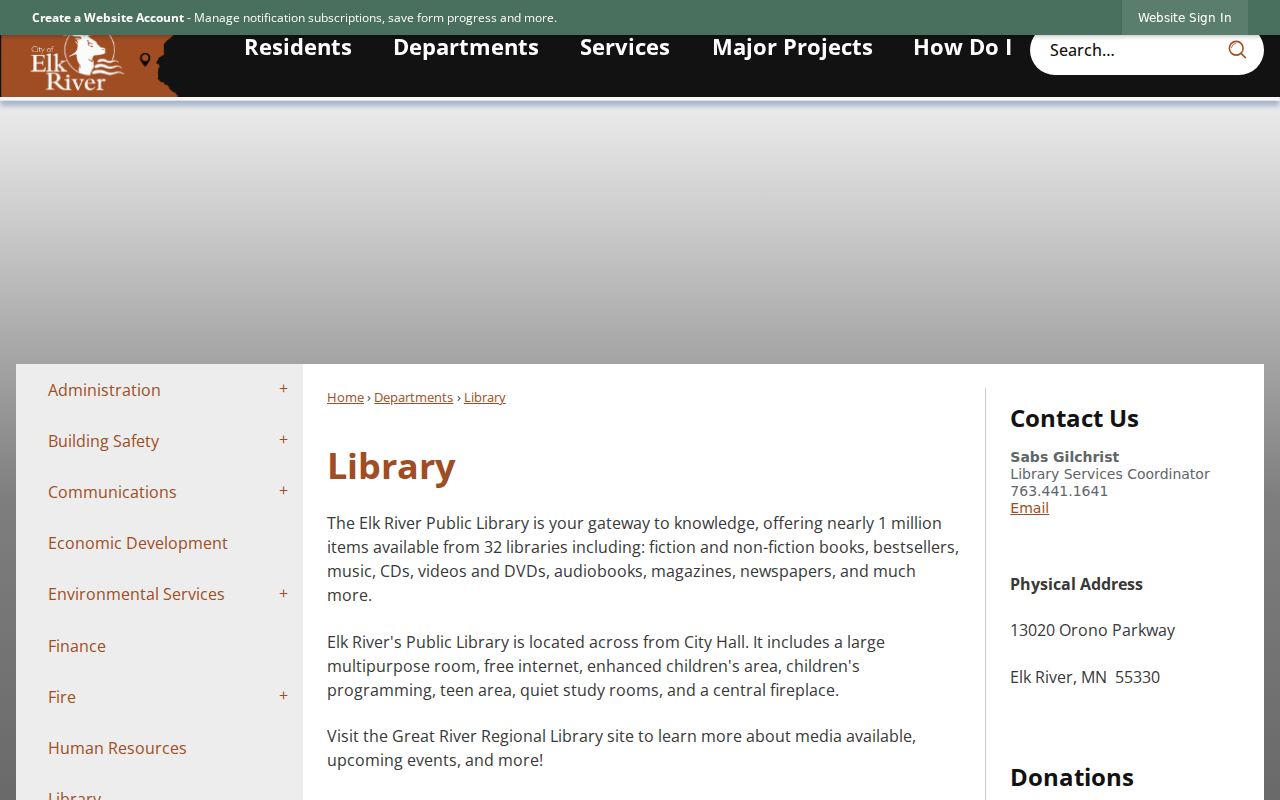
A librarian can help identify the right collection or request path, but no dedicated online house-history guide was documented. For deeper county material, the Sherburne History Center research request accepts a name, contact details, desired date and time, and a research description. The History Center and cemetery associations are the appropriate contacts for names connected to Meadowvale, Orono, Vernon or St. Andrew's cemeteries; no interactive local interment search was documented.
Use obituaries, probate records and cemetery dates as transition evidence. They can explain an estate, family relationship or death, but should be read alongside the address and the actual record date. Note: A library or archive referral is a documented access path, not proof that any one collection contains the desired household.
Elk River Previous Residents Assessments
Assessment rolls are especially useful when title does not change for many years. Sherburne materials describe assessment rolls beginning in 1859-60, irregular coverage through 1901, and sample decade series through the 1990s. Tax lists run incompletely from 1860 through 1901, with later sample decades. These sources can place a taxable owner or property in an intervening period, but they do not prove that every person linked to the property lived there.
Use the assessment year to choose nearby directories, a census year, deed date and newspaper search. For an address that appears to disappear, compare the legal description, old plat and municipal wording. Elk River was platted in 1865 and incorporated in 1880; records may use Elk River, Orono, Lower Town, a township or a subdivision reference rather than one modern address format. The county historical finding aids preserve board minutes, road records and chattel mortgages as further context when a basic address search reaches a dead end.
Elk River Previous Residents Limits
Absence in one source is not a final answer. A phone listing may be unlisted, a directory year may be missing, a census may use a different place name, and an owner may never have occupied the property. There is no documented unrestricted online voter lookup for filling household gaps. Minnesota voter information follows a statutory request process and is a presence clue only, subject to protections and lawful-purpose limits.
Use source dates rather than a single label such as former resident. The strongest result pairs a parcel identity, a specific title event and an independent dated household clue. That method respects the difference between land, tax correspondence and people, while leaving protected addresses and unlisted household members out of the record trail.