
Elk River Neighbors Block Sources
Public records answer different questions about an Elk River block. County parcel geometry identifies land beside an address. Beacon adds tax-linked property fields. The Recorder adds changes in title, and the limited voter route can supply a lawful civic record under Minnesota rules. City packets can add public project or hearing context. None of those sources is a complete household directory. Use each one for the narrow fact it actually documents, and keep an owner, a voter and an occupant as different categories until independent records agree.
| Block source | What it can show | Documented access |
|---|---|---|
| County GIS parcel geometry | Adjacent parcels, building and street fields, PID, plat, block and lot | Public map or query service, with a 2,000-record limit |
| Beacon property record | Owner, situs and mailing fields, classification, values, homestead and legal description | Free basic data; additional CAMA data is fee-based |
| Recorder records | Deeds, liens, mortgages, plats and ownership changes | RecordEASE payment access, counter or known-document request |
| Public voter information | Eligible names, address, year of birth, voting history, phone if supplied and districts | Statutory request by a registered voter for a lawful purpose |
| City planning and permits | Public applicants, hearings, projects and address context | Forms or public packets; no public permit-result index was found |
| GRRL and History Center | Older directories, notices, obituaries and organization context | Library research or a scheduled History Center request |
An owner field can identify the person linked to land and tax correspondence. It cannot establish that person lives at the property or that every Elk River neighbor in a household is named. A map is even narrower: it shows parcels and boundaries, not residents. Note: Record the date of every parcel and ownership result because a current tax record can differ from an earlier deed or directory.
Elk River Neighbors GIS Fields
The Sherburne County parcel service is the practical starting point for an immediate block. It supports map, query, identify, find and export operations. The Elk River Utility layer documents parcel polygons built from COGO or AutoCAD and joined to the assessor tax database by PID. A researcher can query a street, use geometry or selection around a subject parcel, then gather adjoining PIDs before reviewing each parcel in Beacon.
| GIS field family | Block meaning |
|---|---|
| PID or PIN | Stable link from the mapped polygon to assessor and recorded-property research |
| BLDG_NUM, street, type, suffix and unit | Address components used to sort or distinguish nearby parcels |
| Plat, block, lot and acres | Legal and subdivision context for comparing adjacent land |
| OWNER_NAME, OWNER_ADD and TAX_ADD | Tax-linked owner and correspondence fields, not a household roster |
| Mailing city, ZIP and ZIP4 | Mailing attributes that can differ from the physical parcel's jurisdiction |
| Land and building estimated market values | Assessment context, not evidence of a person at an address |
The query layer supports SQL, statistics, ordering, distinct values and pagination. It also has a 2,000-record cap. The research did not verify a visible buffer control, popup order or live adjacent-parcel screen. Use documented map selection or a spatial query instead of claiming a particular button exists.
The county GIS access is represented by the Sherburne GIS viewer.
The viewer is useful for locating parcel geometry, but Beacon and Recorder records remain the next checks for the fields and dates behind a polygon.
Map Elk River Neighbors Parcels
Use the block workflow for a few adjacent parcels, not as a claim that a whole street has been identified. Geometry is the first filter. The PID and legal description carry the result to property records. The owner field is then read as a land link, with the situs and mailing fields kept separate. This order prevents a map label from being mistaken for a current household list.
- Find the subject address in county GIS or Beacon and copy the precise situs, PID and legal description.
- Use map browse, Identify or a spatial selection around the subject polygon to collect the PIDs and addresses that physically adjoin it.
- Open each adjoining PID in Beacon. Preserve the owner name, mailing address, situs, classification and legal description as separate fields.
- When a change in ownership matters, use the legal description and owner names in RecordEASE, then record the deed type, date and document number.
- For a full named-street record chain, use the Elk River street directory rather than extending a small block search beyond its purpose.
GIS can query a street name and sort by building number, but a street query should still be checked by parcel geometry. ZIP alone is not enough. The city's own materials say 55330 covers a larger area than the city limits, so a mailing result does not settle whether a property lies in Elk River or has a particular city service.
Elk River Neighbors Address Meanings
Three related fields often get confused in a neighbor search. A situs address is the physical location of land or a building. An owner or tax mailing address is where correspondence is sent. A legal description identifies the parcel in a plat, lot, block, section or other land format. County GIS exposes both owner and tax mailing-address families, while Beacon and the Recorder use different keys. Comparing them is useful, but neither mailing field names a live household.
Homestead is another careful clue. County property documentation includes a homestead classification, but it is an assessment classification, not a current-occupant list. An out-of-area mailing address may describe a tax contact, an owner or an entity relationship. It does not prove a property is vacant, identify every occupant, or show who receives mail inside the home. Keep the source label in notes so later research does not convert tax data into a claim about Elk River neighbors.
For an unclear address, work backward from the PID and legal description. The Recorder indexes recorded transactions by grantor, grantee, document type, date and land description, not as a general block resident search. A known document number also supports the Recorder copy-request form; the office does not look up missing document numbers on that form.
Elk River Neighbors Voter Route
Minnesota has no unrestricted online neighbor-voter search. Under Minn. Stat. §201.091, the county auditor's master list is restricted. The public information list is narrower and can include name, address, year of birth, voting history, a phone number if supplied, and applicable districts. It omits full dates of birth, Social Security numbers, driver-license or state-ID numbers, military and passport identifiers, ballot choices and presidential-nomination party choice. A safety statement can withhold a voter name.
The lawful route is a request, not a casual block lookup. A registered Minnesota voter may inspect a public list without cost or request a copy or electronic medium with identification and a written lawful-purpose statement. The permitted purposes are elections, political activities or law enforcement. The result cannot be republished as a searchable online database or transferred outside those purposes.
The full-list request form allows City/Town or Ward/Precinct geography, a street-sorted walking list, and formats such as text, PDF or mailing labels. It asks for requester and certification details, and lists $30 for local geography, $46 statewide, up to ten days of processing, and encrypted-email delivery. An individual voter-information form is the narrow route for one voter and is returned to the county auditor where the voter lives. Neither form proves present occupancy.
Elk River Civic Block Contacts
Official sources provide public-facing civic contacts, not a neighborhood-association member list. Elk River's boards and commissions include Heritage Preservation, Parks and Recreation, Economic Development Authority, HRA, Planning Commission, Community Event Center Commission, Utilities Commission and related parks groups. Meeting packets, applications and public hearings can document public participation, an applicant or a property proceeding. They should not be read as proof that a person is a neighbor or a member of a private organization.
| Public civic contact | Useful block context | Documented route |
|---|---|---|
| Boards and commissions | Public meeting, commission and hearing context | City boards and commission list |
| Planning contacts | Public planning applications and hearings | City Form Center |
| Building Safety | Permit requirements and property or PID request route | Building Safety |
| History Center and cemetery associations | Historical organization, cemetery and community context | Sherburne History Center |
The city board inventory is shown on the official civic-groups source.
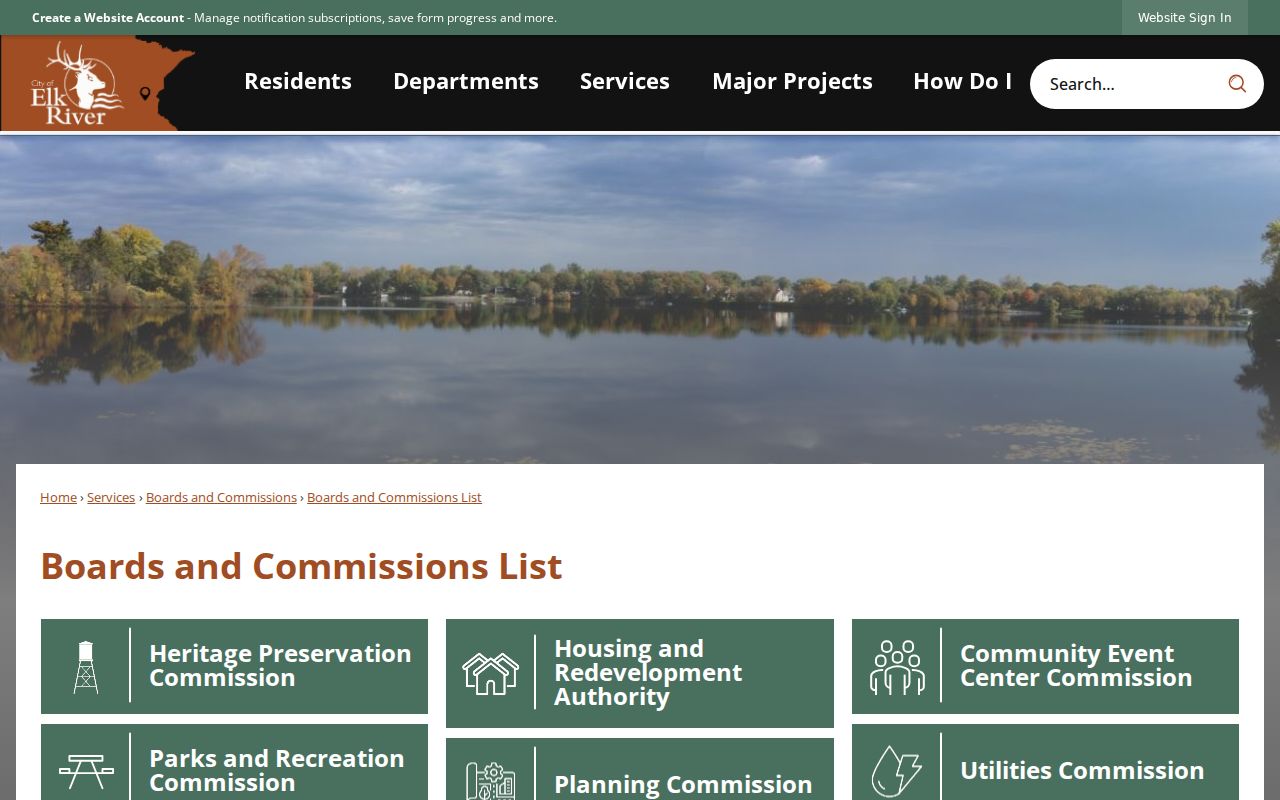
This public civic layer can point to agendas, contacts or property context. The research found no official citywide neighborhood-association or HOA member directory, so no neighborhood names or membership claims belong in a block search.
Elk River Neighbors Tools Compared
Official sources and commercial neighbor tools serve different purposes. County systems have known custodians, field definitions and access limits, but they can be incomplete for a household question. Commercial services may combine address, phone and public-record data, yet duplicate names and stale addresses make them a poor authority for a block. Treat a result from either category as a dated clue that needs corroboration, not as a basis for contacting or profiling a person.
| Official record route | Commercial neighbor-tool category | Safer reading |
|---|---|---|
| GIS and Beacon | Address and public-record compilation | GIS shows geometry; tax fields show land-related data, not all occupants |
| Recorder instrument | Ownership-history compilation | A deed establishes a recorded transaction and date, not present residence |
| Lawful voter-list request | People-list compilation | Use only through the statutory route and permitted purpose |
| Library or archive record | Historic-address compilation | Confirm the printed date, place name and collection before drawing a conclusion |
County access also leaves some data outside a web search. RecordEASE has payment-gated access; the Recorder counter and a known-document request are documented fallbacks. City building materials describe application fields such as property address or PID, valuation, work description, plans and site plan, but no public permit-result viewer was found.
Elk River Neighbors Historical Context
For a past block, GRRL and the Sherburne History Center are more useful than guessing from a modern parcel map. GRRL's Elk River branch offers public computers, genealogy databases, interlibrary loan and librarian help. Its resources point to in-library Ancestry Library Edition, FamilySearch, Minnesota Historical Society indexes, local newspapers and obituary tools. The St. Cloud Times index covers 1928 through 2008 and can lead to a notice that needs a librarian copy or source check.
The History Center accepts a scheduled research request with a name, contact information, requested date and time, and a description of the question. It also connects historical researchers with cemetery information and county finding aids. Telephone directories can be dated address clues, but the official MNHS finding aid does not verify a complete Elk River reverse-directory run. Ask the library or Gale Family Library whether an address-arranged volume exists for the selected year.
Newspaper, cemetery and civic records can explain community ties around a location. They cannot prove a current household. Note: Keep dates and spelling exactly as found because Elk River, Orono, township and plat wording can vary across older records.
Elk River Neighbors Privacy Limits
Important parts of a block remain private. Parcel records do not name all occupants or household members. Utility and delivery information is not a public neighbor list. Driver-license address data is protected, and sealed or expunged cases are not a source for a block search. Safe at Home participants receive a substitute PO Box through the Minnesota Secretary of State, while their real address receives confidential handling. Do not try to infer or publish a protected location from related public records.
Minnesota's Consumer Data Privacy Act does not erase every government record, but it does not override Safe at Home, voter, court, vital-record or DMV rules. In addition, Minn. Stat. §609.748 treats repeated intrusive or unwanted conduct affecting safety, security or privacy as harassment and provides for restraining orders. A public address never authorizes surveillance, repeated contact or publication of protected details.
Lawful use. Use Elk River neighbors records for personal, civic or historical questions and keep the source and date with each result. Do not use an address, parcel or voter record to follow, threaten, intimidate or harass anyone.